
























Dr Kathryn Mannix, author, physician and campaigner, shares her experience of putting together an edition of Future Healthcare Journal focused on palliative care.
It is an unusual honour to be invited to guest edit an academic journal, certainly when you’re not an academic. I had a brief incarnation as an oncology research fellow in the 1980s, but I found that I was more drawn to finding the solution to individual patients’ symptom problems than to waking them to draw their blood at midnight. When, after 9 months of painstakingly centrifuging and freezing those midnight samples, the whole lot defrosted over a weekend when the ward housekeeper unplugged the freezer to plug in her floor polisher, the writing on the wall was as clear as the water on the floor.
While I’m making confessions, I should add that I have now been out of clinical practice for 10 years. Yes, it’s a whole decade since I attended a ward consult, conversed with an outpatient or led a ward round. So why on earth did the editorial team of our own college’s Future Healthcare Journal invite me to be a guest editor?
Well, I think it may be because I took early retirement to attempt an odd experiment. As a palliative physician working in hospital, community and hospice settings, I was acutely aware of how unprepared people are – the people who are our patients – for any discussion of their mortal state in general, or of their approaching death in particular. This difficulty consistently wrong-foots clinicians who attempt to broach those important topics, and it reinforces the disinclination to ‘go there’ of clinicians who are death avoidant. I wanted to do something – but what? – about public understanding of dying.

By a series of unexpected coincidences my campaign took off, initially because I was invited to speak about dying on national radio, a broadcast that was heard by a literary agent. He approached me to ask whether I might be interested in writing a book, With the end in mind. The book of end-of-life stories that I wrote (and the contract he negotiated for me) made that book an international bestseller. That’s quite a journey from the chaotic puddle of my defrosted research. Being a credible witness about the process of dying from nearly 30 years as a palliative physician has generated myriad other opportunities to speak, write and broadcast on that topic across the UK and around the world. Most of all, it has generated a fascinating postbag, an enormous conversation with the public, and those communications have shown me what people want to know. Their messages have three clear topics.
The first is how freeing and helpful it is to be told, in some detail, what the process of dying looks and sounds like. This deconstruction of the process allows dying people to be less fearful of a much-feared yet unlikely soap opera-style death involving suffering or sudden collapse, and it allows already bereaved people – or those currently accompanying a person during the latter stages of dying – to interpret the changes in energy, awareness, breathing, muscle tone, skin colour etc that are otherwise misinterpreted as terror, suffering or choking. Explaining that dying, like giving birth, is a bodily process with recognisable phases and stages helps them to track its progression, reassure themselves that what they see is ‘normal’, and place themselves along its timeline. Information is consoling.
The second is correspondents’ perplexity at approaching conversations about dying, death, wishes for care, boundaries for interventions, and other important matters pertaining to the care of a family member or friend, or of their own wishes, at the end of life. ‘How do I begin?’ ‘What if they get upset?’ ‘What if I get in trouble for raising it?’ ‘Perhaps this is someone else’s job?’ ‘I don’t know where to start.’ What has become abundantly clear, also, is that healthcare professionals feel that same perplexity, and they ask me exactly the same questions.
Medical perplexity, I think, explains the third topic.
Countless people have told me that when their beloved person was dying, the clinicians gave them medical information, perhaps in lay language: abnormal heart rate, struggling kidneys, under-performing liver, low blood pressure, overwhelming infection, along with explanations of the measures being taken to address these physiological challenges. ‘Why didn’t anyone tell me that s/he could die?’ they demand: the third, and practice-challenging, topic. Somehow, these anxious and non-medical visitors did not interpret the morbid information they were being given as ‘sick enough to die’. We know that this is not good enough. At that point in a patient’s illness, the possibility or likelihood of dying might be the most important information to communicate.
And so, I've come full circle.

After 10 years of telling death stories to the public, to discover that, far from being taboo, talk of death intrigues almost everyone provided we can speak of it calmly and with insight, I am turning back to my healthcare colleagues. There has been a mass forgetting about the process of dying, affecting both the people we serve and the profession we belong to.
Professor Kathryn Mannix
Author, physician and campaigner
Regardless of specialty, it is time to reclaim that knowledge, to refamiliarise ourselves with dying: understanding, describing, recognising and supporting that process, and stepping up to demystify it for the patients and their companions who are preparing for it. These are skills we must work to acquire, polish and preserve by regular use and reflection, just like so many other medical skills. Palliative care specialists may supplement the care you provide, but dying remains every physician’s business.
This, then, is why I was invited to choose topics and commission articles for an ‘end of life’ themed issue of FHJ. I hope that the journal we have curated will enlighten, entertain and provoke. Topics range from a brilliantly illustrated comic of CPD updates in palliative care to an exploration of the potential use of AI for prognostication; a review of the ‘state of the art’ from palliative care’s early beginnings in the modern hospice movement to an established medical specialty that is under significant threat from inequitable commissioning; another paper asks how palliative care might look by 2050 – if it survives. There are insights from the sharp end: experts in emergency, palliative and intensive care medicine regularly meet people experiencing anticipatable crises who had no idea that their medical condition was progressive or life-limiting. Three such experts make a plea to colleagues in all specialties to step up to anticipatory care planning (ACP) conversations – in fact, our debate asks whether failure to offer ACP should be a ‘never event.’
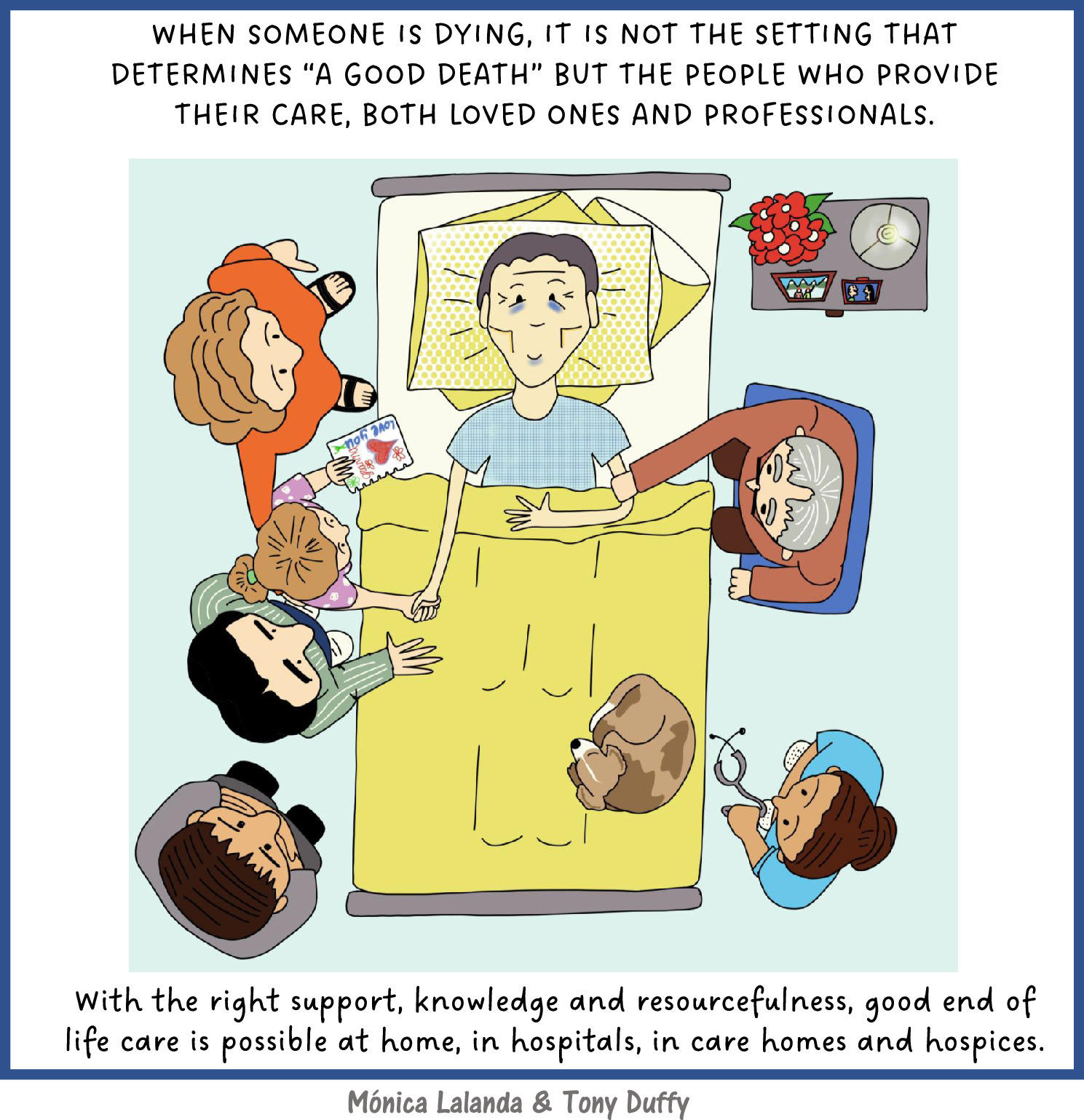
Image: An illustration from FHJ
We have moved the dial on discussions of assisted dying (AD) by offering a thought-provoking, nuanced and calm exploration between an Australian and a British palliative physician of the impact of legalisation of AD in New South Wales on patients, families, staff and the system itself, as the journal’s first video article. Another paper examines how best to offer patient-centred and joined-up health and care services across community and inpatient settings as an individual’s health deteriorates and their needs change: geriatrics is leading the way.
Meanwhile, recognising the impact on ourselves when we work with patients reaching the end of life is also important: an experienced occupational psychologist offers some challenge, some wisdom and some consolation. There is a paper about how to talk about dying, of course. Most important, in my opinion, is a paper written by a patient: a young man with motor neurone disease, who communicates (and wrote his article) using eye-gaze technology, writes of the importance of understanding what it is like to be the patient, a judgement that only a patient can make and an insight that we can only attain by listening.
It is uplifting and humbling: like every day in medicine.
Dr Kathryn Mannix
Author, physician and campaigner