



























Dr Maisam Akroush is a consultant gastroenterologist in Jordan, who made history as Jordan’s first female gastroenterologist and hepatologist. She is also founding president of the Pan Arab Women Physicians Association. In an interview, she spoke to Commentary, sharing the story of her career and how she is working to support female physicians in the Middle East.
After graduating from the University of Jordan School of Medicine, I started to specialise in internal medicine and gastroenterology in the Royal Medical Services of the Jordanian Armed Forces. I began a gastroenterology fellowship in the Royal Medical Services, through a scholarship from the Jordanian Ministry of Health. This scholarship was extended to UK hospitals, where I worked for 2 years and sat my PACES exam.
I returned to work in Jordan for 4 years in a public hospital, the Prince Hamza Hospital, where I gained a lot of experience. I then moved to the private sector to start my own practice in Amman. Career development in the private sector was not an easy task, carrying a lot of challenges; I was the first female gastroenterologist in Jordan, it used to be a male specialty. It was not easy initially, but trust from patients and their word-of-mouth recommendations helped everything go smoothly.
I worked as a part-time visiting consultant to Dubai for 5 years, then came back to Amman, Jordan to continue my practice.
Over this time, I had great mentors, who facilitated involvement with professional as well as volunteer initiatives. I joined patient and public health awareness societies, joining the Friends of Liver Disease Patients Society. I became a research, prevention and early detection advocate through the Mediterranean Task Force for Cancer Control (MTCC) in 2002. Over time, with dedication and hard work, I ended up as the vice president of the MTCC. I was particularly proud when my work on cervical and colon cancers prevention, raising awareness through a sticker on sanitary products, was presented globally.

Being so passionate about medical student education, I started a part-time visiting consultant role at Jordan University. Alongside teaching, I lead research, publications and journal review roles in my academic career. I am also an advocate for medical education and youth empowerment; I have been involved with UK medical colleges to guide residents and early-career doctors, helping to strengthen their portfolios and pursue training in the UK with the RCP Medical Training Initiative. In recognition of my work, I was selected by the British Council as the UK alumni ambassador to the Middle East and North Africa region (2024–2025). I have also become a PACES examiner.
Another special milestone was being acknowledged as one of the 50 RCP fellows who made a difference in their region, in a book published to celebrate the 500-year anniversary in 2018 – Physicians and global health by Krishna Chinthapalli.
My volunteering and advocacy work resulted in a royal recognition and nomination as a member of the Board of Trustees of Jordan Hashemite Charitable Organization, an initiative that supports people in conflict zones and those affected by natural disasters. I was particularly proud to be appointed to a committee to oversee the Jordan Medical Association. I worked hard to show that women can contribute with dedication, perseverance and the courage to stand by their point of view.


These roles have reinforced my guiding belief and rule for my career; my work in medicine is not only a profession, but a humanitarian mission as well.
Dr Maisam Akroush
The Jordanian Women Physicians Conference
We first thought of the Jordanian Women Physicians Conference in 2021 to acknowledge the history of women in medicine in Jordan. We acknowledged all pioneering Jordanian women doctors from every specialty and did our best to reach out to the family of the only female surgeon who died while on duty during the COVID-19 pandemic in Jordan. We were trying to raise awareness that women can be just as empowered as men – and can defend their profession until the last minute. The conference also focused on the most pressing scientific topics, as well as issues related specifically to women’s health. We were honoured to have the RCP represented virtually by Professor Mumtaz Patel, given the constraints of the COVID-19 era.
We stressed that we had very few women in leadership positions at the time – despite being 50% of medical school graduates. After that, it was lovely to see so many societies starting to have women presidents. We also had the first female dean of medical school, president of a hospital and deputy minister of health attending.
The Pan Arab Women Physicians Conference
The following year, this event evolved into the first Pan Arab Woman Physicians Conference and second Jordanian Women Conference, bringing together the expertise of women physicians from 22 Arab countries. The contribution of the RCP was also prominent, and we were later granted the RCP Global Women Leaders Programme; the second country in the world to receive this programme.
We gathered not only the Ministry of Health, but all the medical institutions and associations in Jordan. We had women from other health professions, including nurses, dentists and pharmacists. The RCP was with us; Professor Mumtaz Patel, as vice president of education and training, among other colleagues from the RCP, gave a lecture and workshops in person.
We found that women have broken the glass ceiling and are in every specialty. You would be surprised that one of the first female chest and cardiovascular surgeons in the world was a Jordanian physician, Nermin Tuttanji in the 1950s. We learned about the women in the Arab world who were the pioneers in certain specialties; they led development, starting from the 18th century in places.
At the conference, we discussed subjects that had never been explored in the region; overlap between medical specialties, accountability in medicine, climate change and health in the area, medical tourism and how to advance the health sector of our countries.
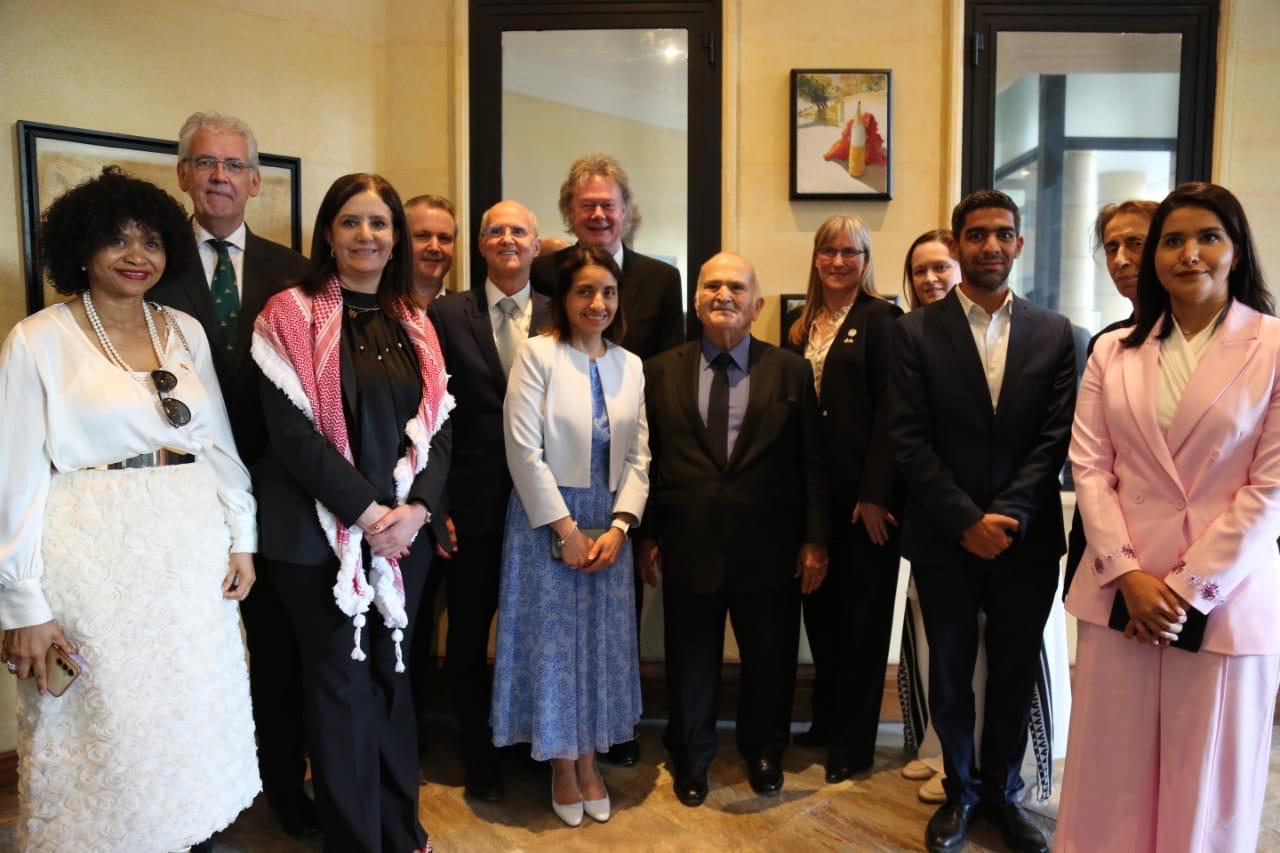
Image: Maisam and Mumtaz at the 2025 Jordanian Women Physician's Conference with other delegates.
The Pan Arab Women Physicians Association
The year after, during the third conference, we launched the Pan Arab Women Physicians Association, the first association of its kind in the region.
The conference continued to be recognised as a well-renowned meeting with a high standard of excellence. We also agreed that future conferences could be hosted by neighbouring Arab countries.
At that third conference, mental health was highlighted as a priority topic; it is still considered taboo in Jordan and not always understood that mental health is a right. It was openly discussed, and real plans were put in place to establish a mental health platform.

Just 6 months later, a platform was launched to provide support for underserved populations affected by conflict and natural disasters (Mentahealth.net). This initiative was guided and patroned by His Royal Highness Prince Al-Hassan bin Talal. We thought that a virtual platform might keep confidentiality and give people the opportunity to be treated, even in conflict zones.
The future of Pan Arab Women Physicians Association and health in the region
Where do I see the Pan Arab Women Physicians Association in the future? I see it as a platform that supports innovation by women in medicine, empowers new generations and young doctors, improves patient care, ensures safety and reduces healthcare burdens by having more helping hands contribute effectively.
We’re very proud of the power of the Pan Arab Women Physicians Association. The conference is to be hosted in different countries; we had the second version in Kuwait. It was also an amazing conference, hosted by our colleagues there, and we will keep going on from one country to another. This will open doors for women to start being the heroes of medical sectors all over the Arab world.
We’re expanding to work with medical organisations and specialties across the world. We are planning to open doors for higher education in the UK, because we felt how the UK graduates in the organisation had our futures sculpted in a different way. We’re opening doors for new groups, like a medical school team; encouraging medical schools to improve on deficits and work on new educational techniques. Next year, the Pan Arab Women Physicians Association is planning to have an Arabian medical meeting, a pioneering idea where every country can partner with us to showcase their achievements in medicine.
We’re even trying to modify some laws; at the moment, Jordan does not have health-related driving licence regulation. There is no age limit for driving – people can have different medical and mental health issues, such as epilepsy, and they’re still driving. We organised an event with the Directorate of Public Security in charge of licensing and street safety, and agreed to try to connect up medical records and licences to prevent endangering the roads.
We’re also conducting research. We had a questionnaire on whether doctors ‘walk the talk’ at our conference; asking if doctors practise what they tell their patients on exercise, alcohol, smoking, and commitment to medication and screening programmes. The Pan Arab Women Physicians Association is running more research now on antimicrobial resistance and educating the population. A third project, that’s about to finish, is on colon cancer and endoscopy – we don’t yet have a national screening programme for colon cancer, so we want to showcase that expenditure on screening is much less than treating cases later on.
The support behind this work
I would love to thank my colleagues, male and female, who supported our initiative, attended the conferences and believed that the Pan Arab Women Physicians Association can make a difference.
The Hashemite leadership in Jordan has opened doors for women and their vision moves us forward; the patronage is always a member of the royal family and also you will always find Hashemite Princesses attending our meeting each year.
We are supported by female physicians from across the Arab world who believe in our mission, by Pan Arab Women Physicians Association members, and by medical and non-medical institutions locally and regionally, as well as national and international colleagues who believed in this initiative from the beginning.
Being an RCP member and fellow changed my vision of my profession; I continue to look at medicine as a mission. So many of the ideas, innovative thinking and the solid foundation to move forward were inspired by the RCP. This milestone in my career would not have seen the light without the continuous support of my beloved college.
Dr Maisam Akroush
We deeply appreciate all supporters and organisers of this unique, one-of-a-kind multisectoral body in the region, honouring the new generation of health professionals for their resilience, precision, dedication and tireless contributions.
I would like to thank all the women who came from their countries to present as health workers and physicians; the Arab world is moving on towards having women as active partners in healthcare.