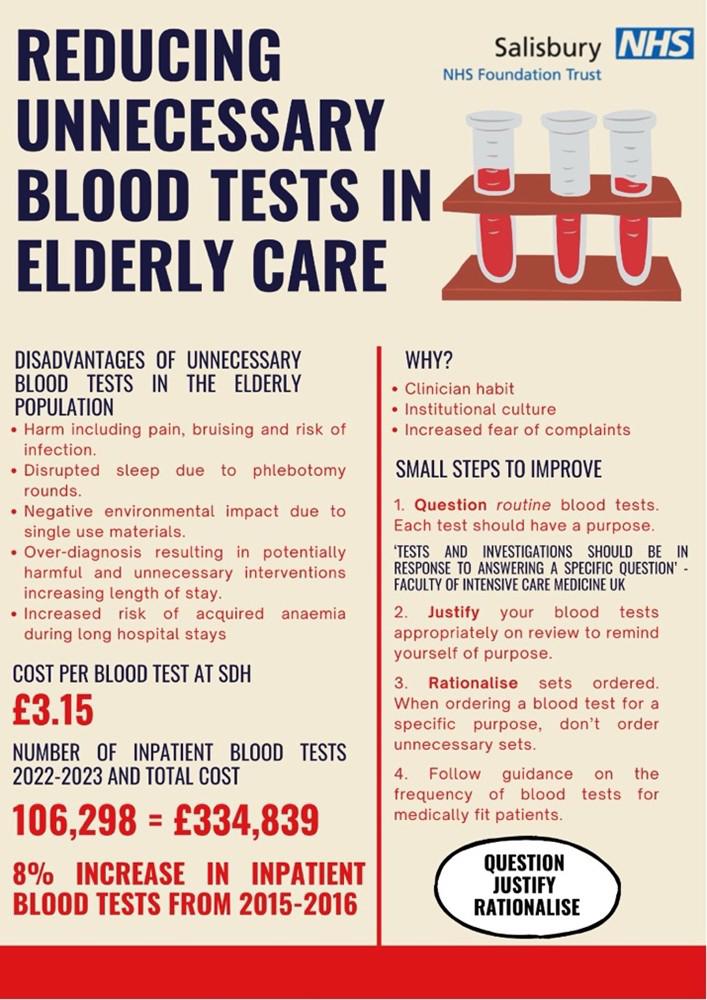

























Targeted interventions to reduce over-testing, improve clinical justification, and reduce harm in geriatric medicine.
The issue
Excessive blood testing is a widespread phenomenon in geriatric medicine. The Carter Review, investigating pathology services in 2016, stated that on average approximately one quarter of all blood tests were unnecessary repeats. Lots of blood tests are associated with numerous disadvantages, including bruising, infection, disrupted sleep, negative environment impact from single use materials, overdiagnosis leading to longer hospital stays, and acquired anaemia due to frequent blood tests during an extended admission.
However, efforts to reduce unnecessary blood tests are often obstructed by clinician habit, institutional culture and fear of complaints.
The solution
This quality improvement project (QIP) aimed to reduce the number of unnecessary and unjustified blood tests at an elderly care ward in a district general hospital.
Data was collected over a period of 14 days from the hospital laboratory, which included the number of blood tests ordered and the number of sets ordered within each test. The blood test requests were reviewed, and the number of tests with sufficient justification was calculated.
An educational infographic was created and widely displayed on the elderly care ward to highlight the disadvantages of unnecessary blood testing. The infographic was also presented at a departmental meeting. Additionally, encouragement and verbal reminders were consistently given during ward rounds. Following these interventions, the same data was collected over a second period of 14 days and compared with the first cycle using unpaired t-tests.
The impact
Data was collected from 40 patients in the pre-intervention cycle as well as the post-intervention cycle. In the first cycle, 158 blood tests were performed, with 914 sets ordered within these tests. In the second cycle, 169 tests with 907 sets were ordered. Although there was no significant reduction in the absolute number of blood tests and sets ordered, the number of targeted blood tests containing one set only increased from 4 to 13 (p=0.01). The number of sets with a sufficient justification provided by the requesting clinician also increased from 50 to 94, but this was not statistically significant (p=0.2).
This QIP demonstrated the high levels of blood testing seen in geriatric medicine. Although the intervention failed to achieve a meaningful reduction in the absolute number of blood tests performed, the significant increase in the number of single test orders suggests that these were more specific and targeted. There was an observed improvement in the justification of tests, suggesting that clinicians were considering the necessity of the tests prior to requesting.
What’s next?
Although this QIP was performed over a short period, the intervention may have resulted in some behavioural changes when requesting blood tests. Further educational interventions and continuous reminders will be required to overcome clinician habits and achieve a meaningful reduction in unnecessary blood tests in elderly care.
Contributors: Dr Anavi Prakash, Dr Theik Oo, Dr Soe Aye, Dr Carmen Carroll, Dr Jonathan Cullis
Institution: Salisbury District Hospital