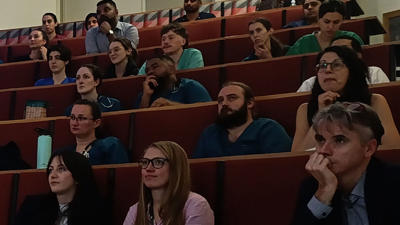

























Senior officers from the Royal College of Physicians (RCP) visited South Tyneside and Sunderland NHS Foundation Trust last week to meet resident doctors, consultants and senior leaders, and to hear first-hand about training, patient care and workforce challenges in the region.
The visit included closed sessions with resident doctors and consultants across a range of medical specialties. It formed part of the RCP’s ongoing programme of college visits to hospitals across the UK to understand local pressures, share good practice and inform national policy work.
Resident doctors spoke positively about the support they receive in Sunderland, describing a culture where concerns are listened to and acted on, with one resident doctor saying, ‘there’s a really supportive culture here. You never feel like you can’t call a registrar or consultant for help.’
‘I think the trust have actually listened to concerns we’ve raised, and you can see the difference. Staffing feels safer and much more manageable now,’ explained a foundation doctor. ‘We get the whole year’s rota in advance, which makes a huge difference.’
Many highlighted proactive rota management, clear communication from medical staffing teams and strong arrangements around induction, study leave and support for international medical graduates.
There was particular praise for the trust’s approach to rostering and workforce planning, with doctors noting that early access to rotas and responsive staffing teams had a tangible impact on morale, work–life balance and training opportunities. ‘Compared to other trusts I’ve worked in, this is the most accommodating and responsive medical staffing team I’ve experienced,’ said one resident doctor.
Consultants echoed these themes, pointing to a strong culture of mutual respect and civility, visible leadership and long standing stability within senior teams. Many highlighted the benefits of working in a trust that combines a district general hospital ethos with opportunities for specialist practice, education and research. ‘We’re large enough to deliver specialist care, but small enough to still feel personal. That balance really matters,’ one consultant told us.
The visit also showcased areas of innovation, including digital maturity, integrated care pathways, virtual wards and developments in renal, stroke, geriatrics and medical education. Doctors described improvements in patient flow compared with other parts of the country, while acknowledging ongoing pressures related to social care capacity and workforce shortages.
The trust has achieved HIMSS Level 7, and one consultant told us: ‘we’re a very digitally mature trust – patients move through their journey without paper, and clinicians can see what they need when they need it. You can access GP records, investigations and letters in one place, which genuinely improves patient care.’
Resident doctors also raised national issues affecting training and career progression. These insights will feed directly into the RCP’s work on the medical education and training review.
Speaking after the visit, Professor Mumtaz Patel said:
‘What we heard in Sunderland was a strong sense of shared purpose. Doctors at all levels spoke about feeling listened to, supported and able to focus on delivering high quality care, even in the context of significant system pressures. That culture does not happen by accident – it reflects sustained leadership and a genuine commitment to training and staff wellbeing. What stood out was the consistency between what residents and consultants told us. There was clear agreement around supportive culture, good training practices and a willingness to tackle problems together.’
Dr Omar Mustafa, RCP registrar, added:
‘Our visit to Sunderland showed how thoughtful rota design, effective workforce planning and continuity of leadership can make a real difference to training quality, staff wellbeing and clinical delivery. These insights will directly inform our work on medical education, training standards and workforce policy, and help us connect colleagues across the country to share and learn from good practice.’
The RCP will feed back to the trust executive team in writing.
The outputs from these discussions will inform our policy, advocacy and influencing work and give a voice to our members in northeast England.
Your college, your voice: together we’re shaping the future of medicine
Our visit to Sunderland was part of the RCP’s programme of local engagement. We regularly visit hospitals across England, Wales and Northern Ireland to meet with fellows and members and hear how they are delivering high-quality patient care and education.
Our 18 local networks across England, Wales and Northern Ireland provide members and fellows with access to events, CPD, training and conferences close to home, supported by dedicated regional teams. They offer opportunities to connect with peers, stakeholders and RCP representatives, and ensure local issues are heard at a national level.